
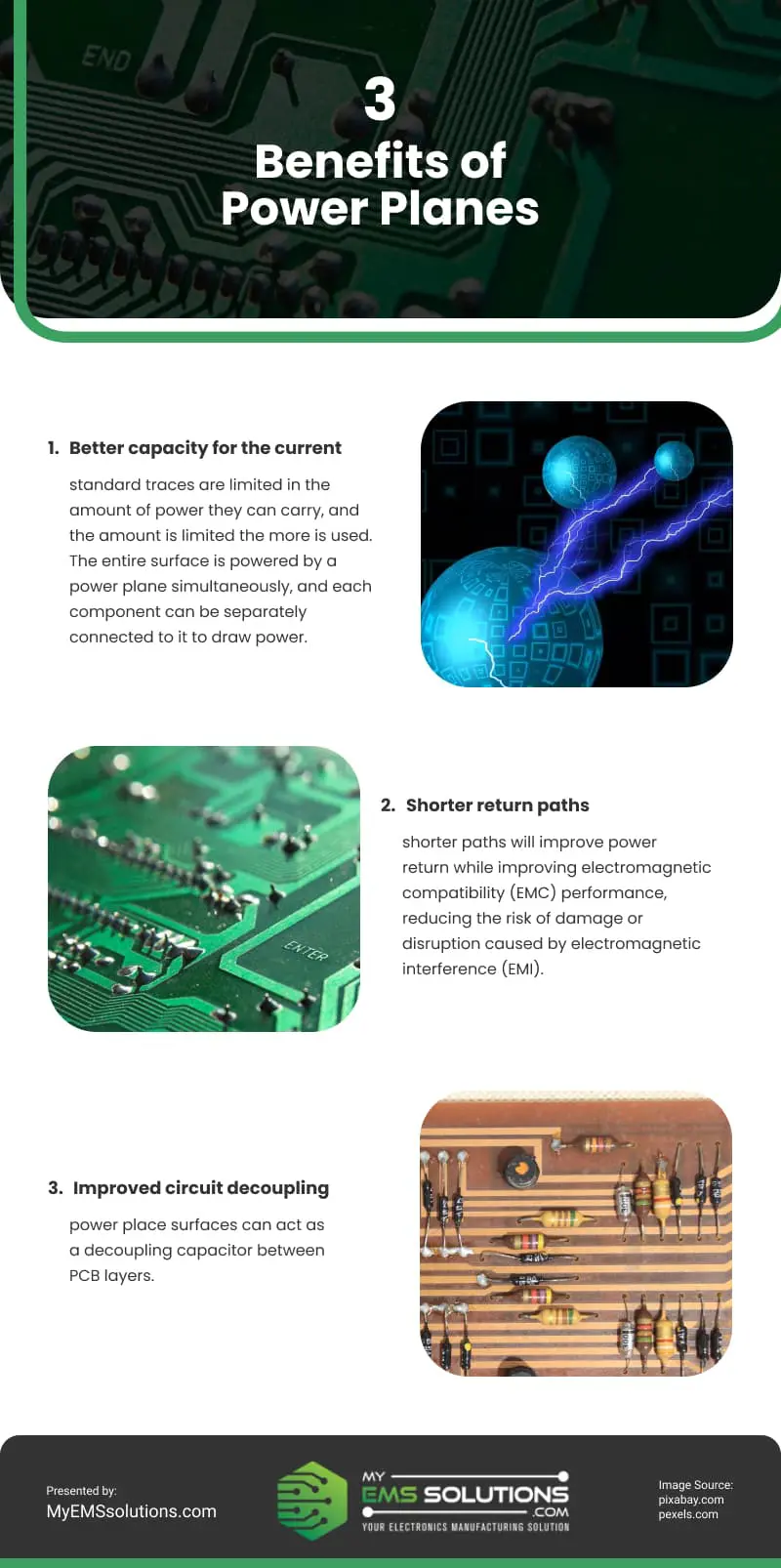
As printed circuit boards become more complex, especially in multilayer designs, traditional power routing through narrow traces is often no longer sufficient. Power planes offer a more efficient and reliable method for distributing power across four-layer and higher PCBs, thereby supporting both performance and stability. Unlike standard traces that are limited by width and current capacity, a power plane delivers energy across an entire surface at once, allowing each component to draw power directly without overloading individual paths. This improves current handling and reduces voltage drops as the design scales. Power planes also create shorter and more direct return paths through strategically placed vias, which enhances power integrity and improves electromagnetic compatibility by minimizing loop areas where interference can occur. By reducing electromagnetic interference, the board becomes more resistant to signal disruption and potential damage. In addition, power planes contribute to cleaner circuit behavior by acting as a natural decoupling element between layers. The large conductive surfaces help suppress noise, limit cross-talk, and stabilize voltage levels across parallel circuits. Together, these advantages make power planes a critical feature in modern multilayer PCB design, enabling higher performance, improved reliability, and better noise control in increasingly compact and demanding electronic systems.
source: https://www.myemssolutions.com/power-plane-pcb-tips-and-best-practices/
Comments
Download this infographic.