
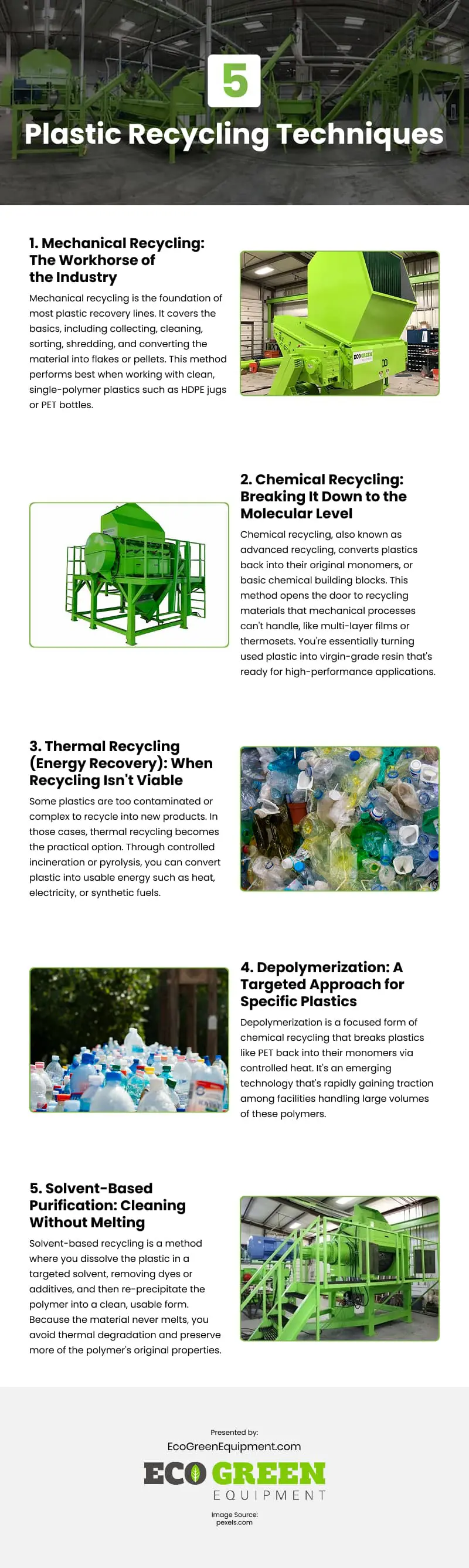
Plastic arrives at recycling facilities in a wide range of grades, contamination levels, and conditions, and the recycling method you choose directly impacts efficiency, throughput, and final material quality. Mechanical recycling remains the backbone of the industry, relying on sorting, washing, shredding, and reprocessing plastics into flakes or pellets. It performs best with clean, single-polymer streams, such as PET bottles or HDPE containers. When materials are too complex for mechanical processing, chemical recycling offers a more advanced solution by breaking down plastics into their molecular building blocks, allowing multi-layer or difficult materials to be converted back into nearly virgin resin suitable for high-performance uses. For plastics that cannot be economically recycled into new products due to contamination or composition, thermal recycling provides an alternative by converting waste into usable energy through processes such as pyrolysis or controlled incineration. Depolymerization employs a more targeted chemical approach, especially effective for polymers like PET, and is gaining momentum as facilities seek higher-quality recovery options. Solvent-based purification adds another layer of flexibility by dissolving plastics to remove additives without melting them, preserving polymer integrity and improving output quality.
source: https://ecogreenequipment.com/different-plastic-recycling-techniques-explained/
Comments
Download this infographic.