
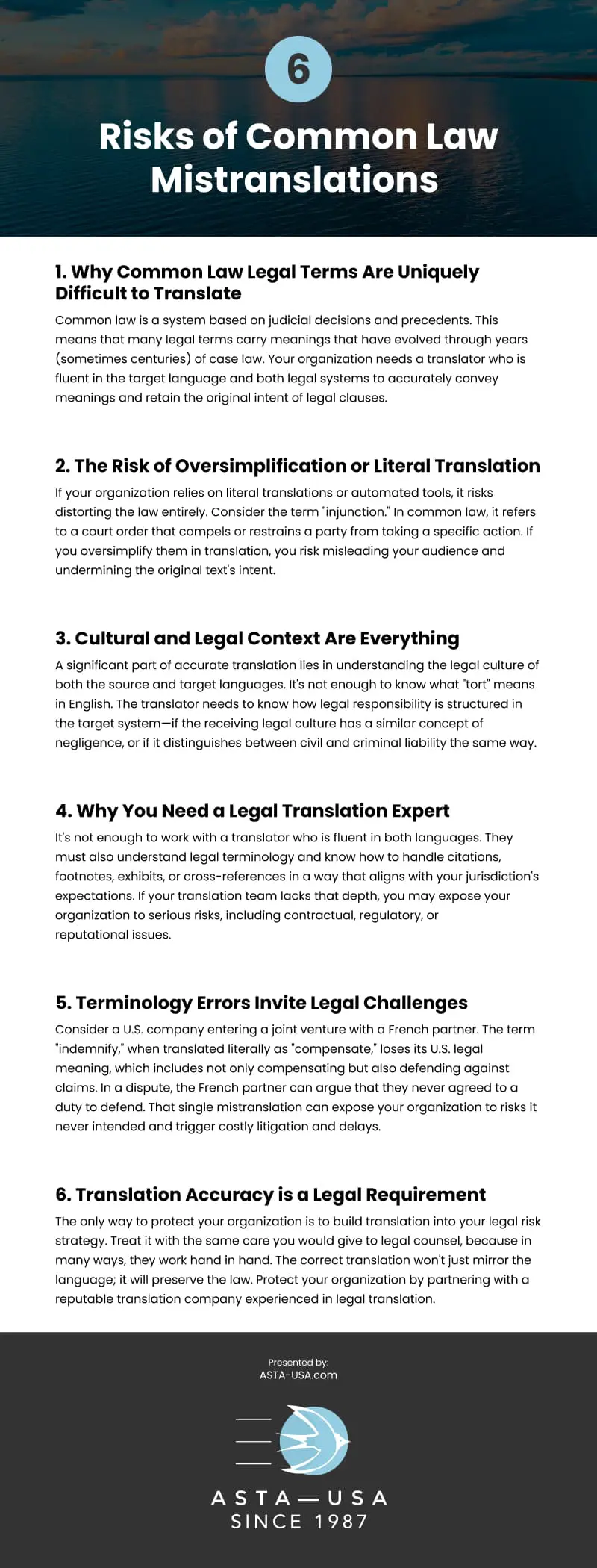
Translating legal documents that rely on common law terminology requires more than just general language fluency, as accuracy in these contexts directly impacts rights, obligations, and legal outcomes. Common law terms are shaped by decades or even centuries of judicial interpretation, meaning their true significance often extends beyond dictionary definitions. When these terms are translated without a deep understanding of both the source and target legal systems, the original intent of a clause can be altered or lost entirely. Literal or automated translations often oversimplify concepts, rendering precise legal instruments into vague or misleading statements that can lead to confusion or dispute. Accurate legal translation also depends on cultural and jurisdictional context, as legal systems do not always share equivalent concepts or structures for responsibility, remedies, or enforcement. A skilled legal translation expert understands how to preserve meaning while adapting terminology to fit the expectations of the target legal environment, including proper handling of references, exhibits, and citations. Errors in terminology can expose organizations to contractual gaps, regulatory violations, or costly litigation, sometimes stemming from a single misunderstood word. Treating legal translation as part of your broader risk management strategy ensures that translated documents uphold the law as intended, safeguarding your organization’s interests and credibility across borders.
source: https://asta-usa.com/how-mistranslated-common-law-terms-put-you-at-risk/
Comments
Download this infographic.