
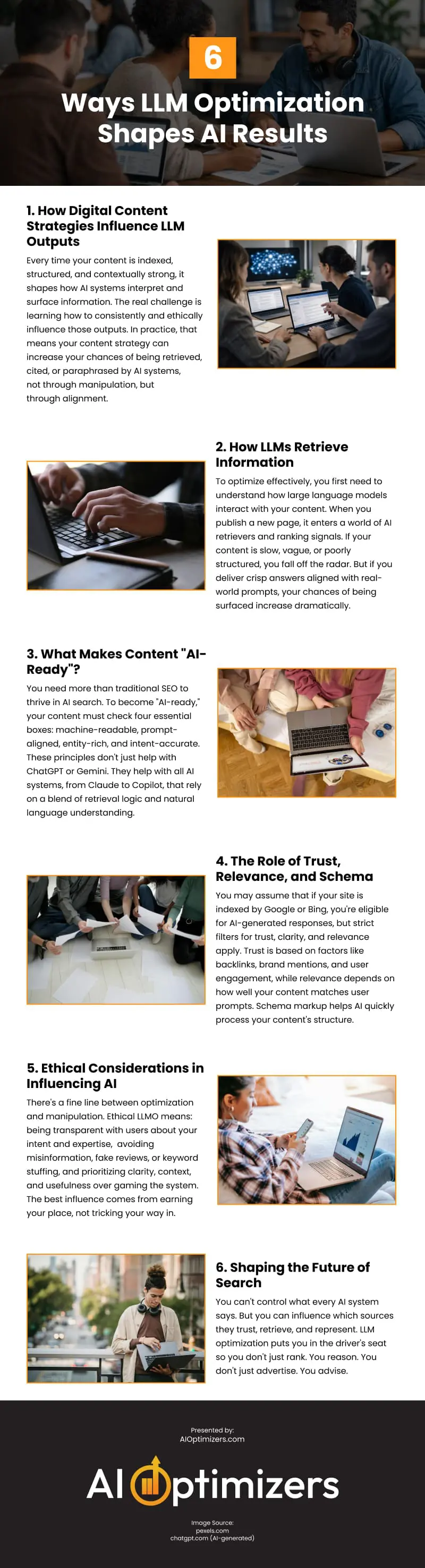
Large language models now shape how people discover and evaluate brands through tools like ChatGPT, Perplexity, Gemini, and other AI-driven assistants, which is why LLM optimization focuses not only on improving discoverability but also on how “recommendable” your brand becomes in generated answers. Your digital content strategy directly influences what these systems retrieve, cite, and paraphrase, especially when content is indexed, clearly structured, and rich in context and entities. To optimize effectively, it helps to understand that LLMs rely on retrievers, ranking signals, and natural language understanding, meaning slow, vague, or poorly organized pages are less likely to surface. AI-ready content goes beyond traditional SEO by being machine-readable, aligned with real user prompts, entity-rich, and accurate to search intent, enabling it to perform across many AI systems. Trust and relevance also act as filters, shaped by signals like backlinks, brand mentions, and engagement, while schema markup can improve how quickly AI interprets and categorizes information. Ethical LLMO avoids manipulation and instead prioritizes transparency, accuracy, and usefulness, steering clear of misinformation or spam tactics. While you can’t control every AI output, you can influence which sources AI trusts and how your expertise is represented as search continues to evolve.
source: https://www.aioptimizers.com/how-llm-optimization-shapes-generative-ai-outputs/
Comments
Download this infographic.