
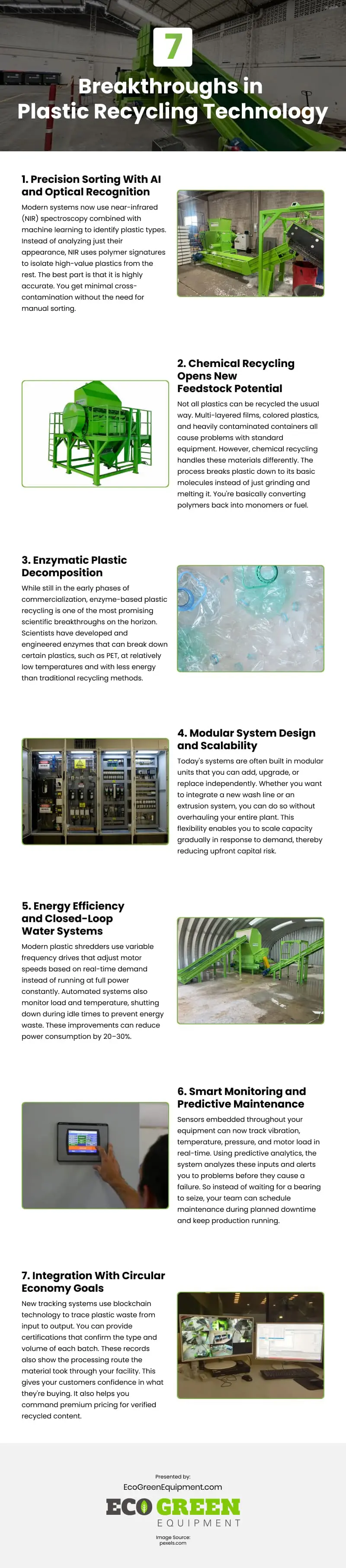
The plastic recycling industry is undergoing a major transformation, driven by new technologies that enable the processing of materials previously deemed unrecyclable. Advanced systems now use near-infrared (NIR) spectroscopy combined with machine learning to precisely sort plastics based on their polymer signatures, improving accuracy and minimizing contamination. Chemical recycling offers a solution for multi-layered films, colored plastics, and heavily contaminated containers by breaking down plastics into their basic molecules, converting them back into usable feedstocks or fuel. Enzyme-based recycling, though still in development, promises to break down plastics like PET at lower temperatures and with less energy than traditional methods. Modular system designs offer flexibility and scalability, enabling plants to increase capacity without significant upfront investment gradually. Energy-efficient systems reduce power consumption by 20-30% through smart motor adjustments and closed-loop water systems. Predictive maintenance is now possible through sensors that monitor equipment in real time, helping detect issues before they cause failures and thereby improving operational efficiency. Integration with circular economy goals is facilitated by blockchain technology, which tracks plastic waste throughout the recycling process. This not only ensures transparency but also allows companies to offer verified recycled content, adding value and allowing them to command premium pricing.
source: https://ecogreenequipment.com/7-revolutionary-advancements-in-plastic-recycling-technology/
Comments
Download this infographic.