
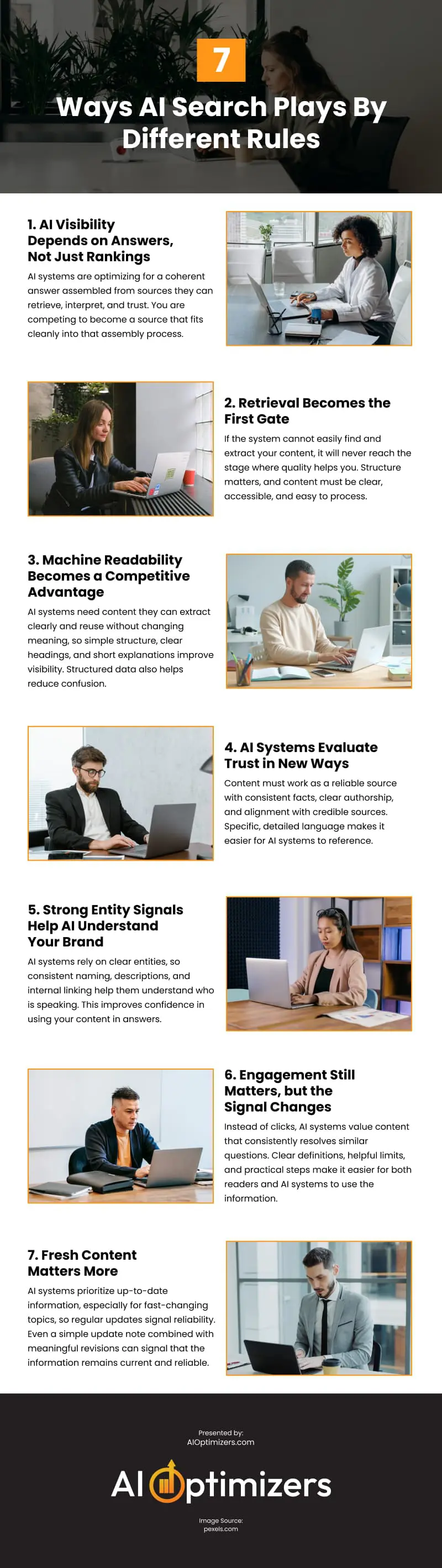
Traditional search engines are built around ranking web pages, while AI search engine optimization is increasingly focused on creating clear, structured, and useful answers that can be easily interpreted and reused by AI systems. This shift changes what “good content” means because visibility is no longer just about ranking position, but about how easily information can be retrieved, understood, and assembled into a coherent response. In this environment, content needs to be both engaging for human readers and structured in a way that makes it easy for machines to extract meaning without distortion. AI visibility depends more on answer quality than rankings alone, meaning content competes to become a trusted source that fits naturally into generated responses. Retrieval becomes the first gate, so if content is not easily found, clearly structured, and accessible to indexing systems, it will never be evaluated for quality in the first place. Machine readability becomes a competitive advantage because simple formatting, clear headings, and concise explanations help systems interpret and reuse information accurately. Trust signals also play a major role, with AI systems favoring content that demonstrates consistency, clarity, and credible sourcing. Strong entity signals, such as consistent naming and contextual linking, help systems understand who is providing the information and build confidence in its use. Engagement still matters, but it shifts from clicks to usefulness, where content that repeatedly answers user intent effectively is more likely to be surfaced. Freshness is also increasingly important, especially for topics that evolve quickly, making regular updates and revisions a key indicator of reliability and ongoing relevance.
source: https://www.aioptimizers.com/7-ways-ai-search-plays-by-different-rules/
Comments
Download this infographic.