
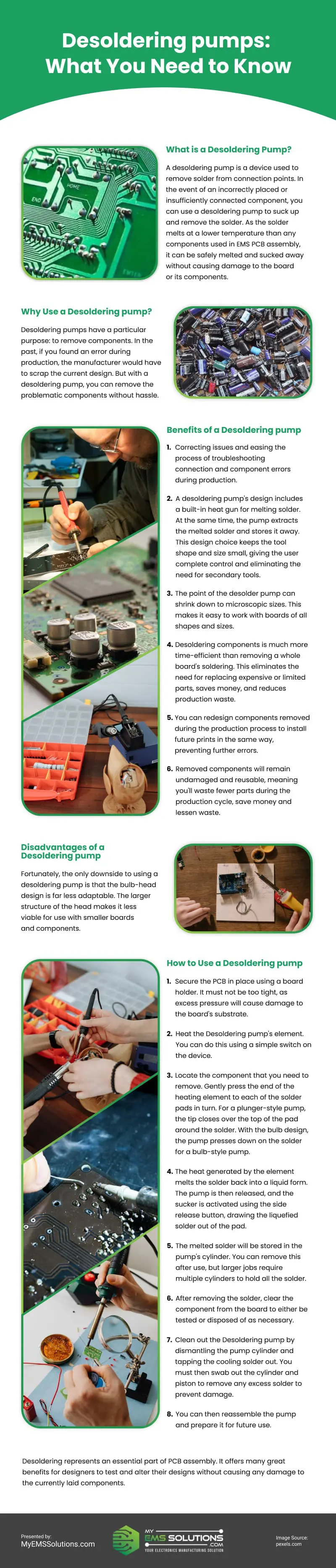
Printed circuit board assembly involves precision, and even experienced EMS teams encounter soldering errors that need correction without damaging the board. A desoldering pump is a practical solution designed to remove melted solder from connection points, allowing components to be safely adjusted, replaced, or reused. Because solder melts at a lower temperature than PCB components, it can be liquefied and extracted without harming the board, making desoldering a reliable fix rather than a destructive reset. This tool transformed manufacturing by eliminating the need to scrap entire boards when a single connection goes wrong. Modern desoldering pumps combine heating and suction into a single, compact device, providing technicians with greater control while reducing the need for additional tools. Their fine tips enable work on boards of varying sizes, including those with dense or intricate layouts, and the ability to remove only the affected solder saves time, money, and valuable components. By preserving reusable parts and reducing material waste, desoldering supports more sustainable production cycles. While bulb-style designs can be less adaptable for very small components, the overall benefits far outweigh this limitation. Proper use and cleaning ensure consistent performance and longevity. In PCB assembly, desoldering is not just a corrective step—it’s an essential process that enables troubleshooting, redesign, and continuous improvement without starting from scratch.
source: https://www.myemssolutions.com/desoldering-pumps-everything-you-need-to-know
Comments
Download this infographic.