
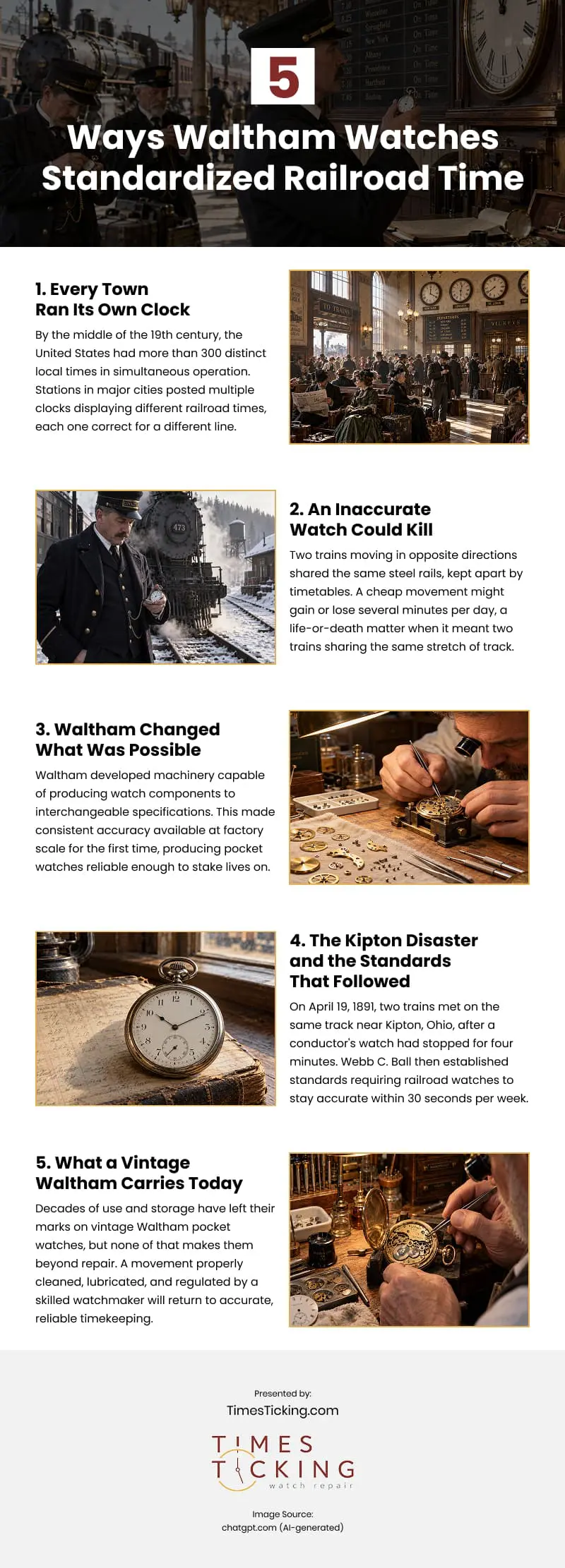
Before the railroads, American towns kept their own time, and by the mid-19th century, the country had more than 300 local times in operation. On single-track lines, trains were kept apart by timetables, so a conductor’s watch that gained or lost minutes could put two trains on the same stretch of track. Waltham changed what was possible by developing machinery that produced watch components to interchangeable specifications, making consistent accuracy available at factory scale for the first time. After the 1891 Kipton disaster in Ohio, Webb C. Ball established strict railroad watch standards, including accuracy within 30 seconds per week. Waltham movements were built to meet them, and today, a vintage Waltham, properly cleaned, lubricated, and regulated by a skilled watchmaker, can return to accurate, reliable timekeeping.
source: https://www.timesticking.com/how-waltham-watches-helped-standardize-railroad-time/
Comments
Download this infographic.


