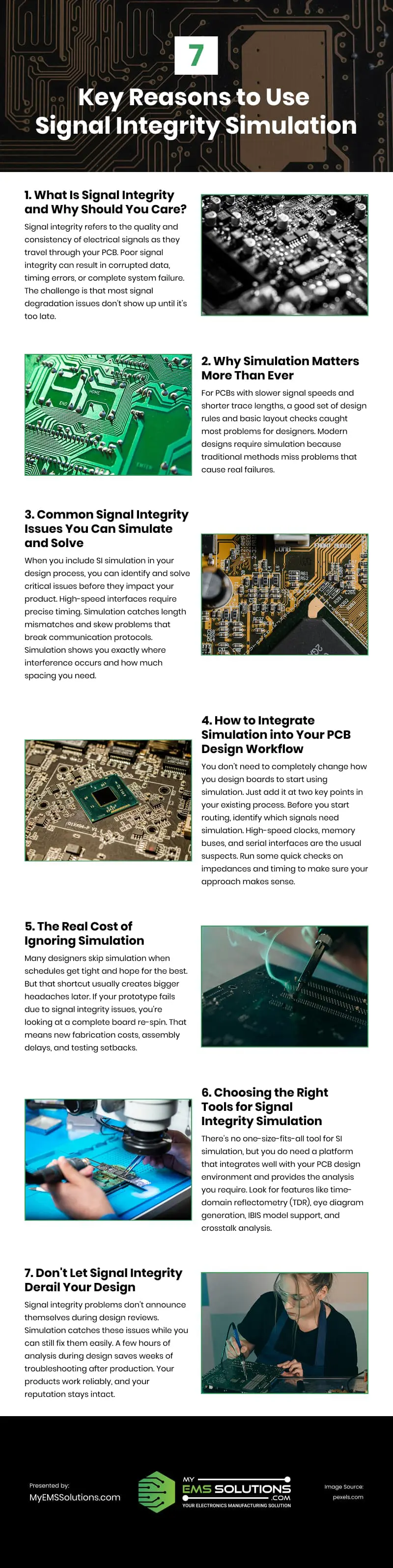
Modern PCBs operate at speeds and densities where signal integrity (SI) has become a critical concern, and traditional design rules often fall short. Signal integrity measures how consistently and accurately electrical signals travel through a PCB, and poor SI can cause corrupted data, timing errors, or complete system failure. In today’s high-speed designs, problems like skew, length mismatches, crosstalk, and interference can silently undermine your board, often only appearing after fabrication, which makes fixes costly and time-consuming. Simulation allows designers to visualize these issues before the board is built, catching timing and impedance mismatches on high-speed clocks, memory buses, and serial interfaces. Integrating SI simulation doesn’t require overhauling your workflow; running targeted checks before routing and validating key traces ensures your signals maintain quality throughout the design. Skipping simulation might save time early on, but the resulting prototype failures can trigger board re-spins, additional fabrication costs, and delayed production. Selecting the right tools, featuring capabilities like time-domain reflectometry, eye diagrams, IBIS model support, and crosstalk analysis, is essential for effective analysis. By proactively using signal integrity simulation, designers can prevent hidden issues, streamline development, and deliver reliable, high-performance products without costly surprises.
source: https://www.myemssolutions.com/signal-integrity-simulation-for-pcb-designers/
Comments
Download this infographic.