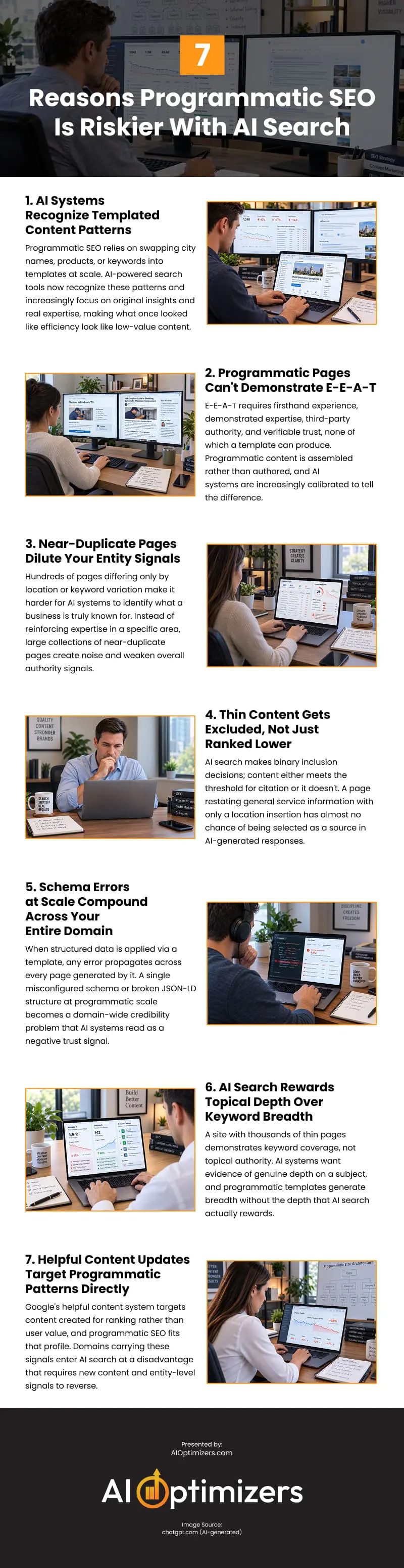
Programmatic SEO built its reputation on scale, but the qualities that made it effective in traditional search are now working against sites in AI-driven environments. AI systems have seen templated content patterns countless times and are increasingly calibrated to identify pages created for volume rather than genuine user value. E-E-A-T signals, experience, expertise, authority, and trust, cannot be produced by a template, and AI systems evaluating source credibility distinguish between assembled and authored content. Hundreds of near-duplicate pages differing only by location or keyword variation dilute entity signals rather than reinforce expertise, making it harder for AI systems to determine what a business is genuinely known for. Unlike traditional search, which ranked thin content lower, AI search makes binary inclusion decisions: a page restating general information with only a location insertion has almost no chance of being cited. Schema errors applied through templates propagate across thousands of pages simultaneously, turning a single mistake into a domain-wide trust problem. AI systems reward topical depth over keyword breadth, and programmatic templates generate breadth without the depth that earns citations. Google’s helpful content system targets exactly this profile, and domains already carrying those signals enter AI search at a meaningful disadvantage, requiring substantive new content and entity-level signals to reverse it.
source: https://www.aioptimizers.com/7-reasons-programmatic-seo-is-riskier-with-ai-search/
Comments
Download this infographic.